Tuesday, 26 February 2013

@The_RHS Chelsea – Feeling the force of gravity

As the last few days of February slip away into oblivion, March looms and I start to feel the force of gravity of Planet Chelsea. It’s not a good idea to flip through the diary at this stage; too few pages separate me from May.  Every year I mean to be ahead of the game, but in reality I avoid the issue until timescale threatens.

Some aspects of this year’s exhibit have bonded in the past couple of weeks.  Organicstone, as ever have felt the force and come up with just the right flooring products for pathway and feature paving. Tom Stogdon has sent through some amazing images of his sculptures. We’ve decided on a building from M&M Timber, and almost decided on colours.  A curious fibreglass object that’s sitting in front of my desk is raising a few eyebrows.  “What is it?” they ask. “Isn’t it obvious?” I reply; clearly not. 

My desk is an untidy heap of papers, brochures, post-it notes and a few scribbled lines on a plan. The Chelsea plant list has got as far as my “things to do” list.  Some of the Chelsea mag is written and the concept clearly explained; well fairly clearly. This year’s theme….I’ll tell you that after Friday. I said I would do that at Hillier Horsham on Friday.  Some already know. But if you do please don’t tell anyone yet. I think every major piece of news needs a release date and in the best media traditions that news is bound to be leaked beforehand.

I was at a conference for Floral Exhibitors (as opposed to Garden Exhibitors and purveyors of garden goods) at The RHS in London last week.  Interesting day talking rules of judging, social media etc.  I thought we would be discussing the Centenary of Chelsea, but that wasn’t really mentioned. Anyway what the meeting achieved was about of a pre-show reunion of exhibitors.  It was nice to get to see the Chelsea family before the show. It means you can get the “it doesn’t seem five minutes!” out of the way early.  

Monday, 7 January 2013

Snowdrops: the new must have book by Gunter Waldorf


Every so often a book comes along that is so desirable that you just have to have it.  When I was first shown ‘Snowdrops’ by Gunter Waldorf that was one such moment.  Although it is small in stature, it has such presence, and such an arresting cover image, that your imagination is captured even before you open it. 
Over the years I have experienced the passion and enthusiasm of galanthophiles.  Yes I have known about snowdrops since I was a child. I remember a clump of these delicate green and white beauties emerging in late winter from a gap between the stones in the sunken rock garden at the front of our house. The buds were pointed, like little green and white penguins, before the pendent blooms emerged. I think gardens then either had them, or they didn’t, they were not plants that you went out and bought.
When I had my first country garden I wanted snowdrops. The front garden was shady and the soil quite heavy, the old brick cottage seemed to demand them.  I bought bunches of snowdrops in the green from a local greengrocers, where they were displayed wilting in a wooden box on the pavement outside. The bunches of snowdrop bulbs, with the remains of flowers and limp leaves, were wrapped in pieces of newspaper.  Gradually over the years the colony grew and they were a feature of every February.  A few were picked by the children for the little glass snowdrop vase that sat dusty on the windowsill until snowdrop time came.
When I started to do more talks and lectures to gardening clubs and horticultural societies I got to know quite a few galanthophiles, mainly through the Hardy Plant Society.  At meetings, single snowdrop plants, grown in pots, were displayed for all to admire on the tables in village halls.  Variety names were quoted by proud owners. Snowdrop forays were excitedly planned to gardens of other galanthophiles. The camaraderie amongst them was enviable, and I felt a bit of an outsider. 
They could obviously see the subtle differences between snowdrop varieties, while I was struggling; they were all snowdrops to me, or were they? I really liked the simplicity of the single snowdrop.  I liked the petals to have that elegant curve. I liked the skirt to be visibly laced with green and I liked slender leaves. I suppose I was starting to look at them a little more closely.
Whether you are like me, you love snowdrops in your broad garden palette, or you are a dedicated galanthophile you will adore this new book: Snowdrops by Gunter Waldorf.  This little gem is a treasure trove of glorious portraits of probably every variety in cultivation, including yet un-named ones.  It shows the subtle differences to perfection and describes them concisely.  300 varieties are photographed, and best of all in their natural setting.
The book tells you all you need to know about growing snowdrops, planting snowdrops, acquiring snowdrops, collecting snowdrops and propagating snowdrops.  It also lists sources of supply and gardens famous for their snowdrops in the U.K. You can both be enthralled and amused by it, or you can become bewitched by it and become a galanthophile.   For existing galanthophiles it is pure indulgence written by one of you; perhaps I want to say one of us?
I rarely read novels, and although I’ve written a few I’m not often drawn to books.  However this has that magical fascination that I’ve found in certain books about plants and gardening over the years. I know I shall still be revisiting its pages when I’m too old to bend low enough to admire these little beauties in the flesh.


Snowdrops by Gunter Waldorf is published by Francis Lincoln
In hardback it measures 170 x 170 mm and has 160 pages with over 300 glorious photographs. 
Published price: £14.99 - Buy it here for just £12.99 – post free U.K. http://www.hillieronline.co.uk/products/gardening-books/snowdrops-by-gunter-waldorf.html

Friday, 7 December 2012

Peaches on the Patio, nectarines too!


Nectarine 'Garden Beauty'
I am all for gardens becoming more productive; after all there is nothing more satisfying than eating something you’ve grown.  Also home grown produce has the taste factor; it hasn’t been chilled, stored handled and packed before you eat it. However on the other hand I do want my garden to look beautiful, especially the parts nearest the house which I look at throughout the year.  I’m just not prepared to tolerate an unsightly plant or container just because it’s producing something edible.  In my opinion a brightly coloured plastic growbag is just not for the patio: it needs to be hidden somewhere out of sight, however good the tomatoes! 
Nectarine 'Garden Beauty'


Blueberries have become deservedly popular subjects for patio pots.  They are attractive shrubs, with tiny bell-shaped flowers that develop into a surprisingly good crop of luscious blueberries. These aromatic and delicious fruits are useful, even in small numbers to liven up a yogurt or your breakfast cereal.  Grow them in ericaceous John Innes compost, keep them watered and in an open sunny position and they will reward with fruit and fabulous autumn colour.

Nectarine 'Garden Beauty'

Peach 'Terrace Diamond'

Now if I was looking for a fruit to team up with a few blueberries I would choose a nice ripe peach or nectarine. I love both, especially when I can pick sun-warmed fruit straight from the tree. They are normally most successful in gardens when grown against a sunny south or west-facing wall; that is unless you grow one of the fabulous dwarf patio varieties. These make exquisite compact miniature standard trees with divine blossom in spring and succulent fruits in summer. Now that’s a productive plant I don’t mind looking at!

The two I would recommend are: Peach “Terrace Diamond”, with single pink flowers, followed by white flesh fruits. It is self fertile and the fruits ripen in mid August. And Nectarine “Garden Beauty”, with double pink flowers, followed by yellow flesh fruits. It is self fertile and ripens in late August and September.
Peach 'Terrace Diamond'
Both are ideally suited to large pots (45cm diameter or more) filled with John Innes No.3 compost. They will require annual feeding with either Vitax Q4 professional compost or rose fertiliser.  In early spring scrape off the surface of the compost, add a handful of fertiliser and top up with more John Innes. The delicate blossoms can be susceptible to frost, because they flower so early in spring. So put your peach or nectarine in a sunny, sheltered situation, or protect with horticultural fleece. Because they are dwarf and compact they are  easy to cover with a horticultural fleece jacket.  
So what do I hate about peaches and nectarines?  Leaf curl!  That’s the fungal disease that causes those red blisters and disfiguration which ruins the otherwise attractive foliage. The problem is the fungal pathogen, Venturia inequalis, the spores of which are spread in rainfall in late winter and early spring.  Here’s the clever bit.  If you put an umbrella over the plant from late December through to March you won’t get leaf curl.  If you have a large tree, or even a peach trained on a wall, that can be tricky. But with one of these patio peaches or nectarines an old golfing brolly will do the trick.  Healthy foliage, beautiful flowers and delicious juicy fruit straight from the tree; what more could one ask for? Maybe one as a Christmas present…………………..


Tuesday, 4 December 2012

Zest for Life: Growing Citrus at home: time to try a kumquat!

Add caption
The smell of citrus, cloves and cinnamon somehow captures the whole spirit of the festive season; a Clementine in the toe of your stocking and a bowlful on the dresser.  A slice of lemon in the gin and tonic, and the zest of the fruit in your mince pies, Christmas cake and pudding; the joys of christmas.
I remember selling the calamondin orange as a Christmas pot plant when I was still at school; we always sold one or two in that last week running up to Christmas, usually to the residents of the expensive apartments on Avenue Road. In those days they arrived individually boxed from Rochfords houseplants, and I remember my excitement at finding a few of stray fruit in the bottom of the box.  This meant I could try them, and answer that question that everyone asked: “can you eat them?”
In fact the calamondin orange, with its small clementine-like fruit was quite bitter and dry, but the flavour was intense, especially from the skin. We always recommended them as an addition to drinks or preserves; whether anyone ever used them was a different matter.
Today I grow a lemon tree in the conservatory in winter and outside on the patio in summer.  At this stage my plant is covered with promising buds, and the small green embryo fruits are swelling.  Any day now a few flowers will open, and fill the cool morning air of the conservatory with their sweet fragrance. The scent is spicier than that of the Jasmine, which blooms in the New Year; heavy and delicious.  Usually by now there are golden yellow ripe lemons hanging on the plant, unwaxed, full of juice and deliciously aromatic; as different from a shop-bought lemon as frost from fire.
So what’s the drawback with growing your own lemons? The plants do go through their unprepossessing stages.  They shed a few leaves; occasionally get scale insects on the foliage, which leave behind those black sooty deposits.  Usually by late spring the plants look a little tired so its time for the summer holiday outside. I cut them back at this stage too.
So what about other citrus? Are they worth growing? One is, and I’ve discovered that it’s the star of the show: The Kumquat.  Small, dark green abundant leaves on compact plants, the kumquat is most attractive grown as a short standard.  It produces wonderfully fragrant waxy white flowers followed by shining green embryo fruits; these eventually develop into golden-orange drops hanging from the plant.  It fruits more freely than other citrus, is more suited to growing on a light, cool windowsill, and is by far the most attractive of all citrus fruits. What’s more the fruits are delicious picked ripe from the plant, in jams and preserves, fruit salads and other deserts. 
All you have to do with your kumquat is five it a light airy position close to a window, or in a cool greenhouse or conservatory.  It is not hardy so will not survive the winter outside, but it does not need heat.  An unheated conservatory that is reasonably frost free is ideal. 
Water your kumquat regularly but do not overwater, allow the compost to almost dry out between waterings. Feed with citrus or tomato fertiliser from spring through to autumn, and by all means stand outside in summer in an open sunny position.  Out on the patio in summer the flowers are more likely to be pollinated by bees and other insects than they are indoors. 
To celebrate your success: Cut a ripe kumquat in half and pop it in the bottom of a cocktail glass.  Add a teaspoon of dry vermouth. Top up the glass with your best vodka straight from the freezer.  Stir very gently with a cocktail stirrer. Enjoy!  After a couple your kumquat will miraculously have more fruit, or at least it will appear so!
A kumquat would make a wonderful gift for any plant lover, with or without the vodka. I would certainly be delighted if someone gave me one for Christmas…..hint……


Wednesday, 14 November 2012

Wonderful Witch Hazels

Hamamelis 'Arnold Promise'
Witch hazels are beautiful, elegant shrubs with fragrant winter flowers. They are usually at their best in January and February regardless of weather, because their delicate flowers are undamaged by frost and snow. However these are not one season wonders; they also have the benefit of superb autumn colour. 

The name witch hazel comes from the North American species Hamamelisvirginiana. Branches of this plant were used by early settlers as water divining rods. As they had the same magic properties as branches of  hazel used at home the plant gained the name witch hazel.
Hamamelis 'Harry'
Hamamelis virginiana is grown as the rootstock upon which our wonderful garden varieties are budded, so whichever one you choose it has magical roots. 


Hamamelis 'Orange Beauty'


Witch Hazels are easy to grow on well drained fertile soil. They prefer neutral to acid conditions and are not fond of shallow chalk. Some of the smaller growing varieties can be grown successfully in large containers using lime free John Innes compost.
Witch hazels make excellent specimen shrubs and can be grown free-standing in grass. They need space to develop and attain their natural shape and spread; pruning ruins this and should be avoided. Size varies with variety, but on average they reach a height of 2 metres with a spread of 2 metres in 10 years.

Hamamelis 'Sunburst'

The best witch hazels are those grown by Hillier Nurseries. They start life in the field, where they develop a robust root system and branch framework, before they are potted and grown on for sale.  They are also true to type which is more than can be said for many inexpensive hamamelis offered for sale.  This is the ideal time to buy and plant your Hillier witch hazel as plants are full of buds and you have those delicate winter flowers to look forward to. Also the wet summer has resulted in spectacular growth so the plants are even bigger and stronger than usual.
  
Think about how you position your witch hazel in the garden: Plant yellow flowered varieties against a dark background such as a large evergreen shrub; plant orange and red flowered varieties where the flowers will catch the morning or afternoon sun.

Here are my favourites:

Hamamelis mollis ‘Wisley Supreme’: A large shrub, upright habit. Pale yellow sweetly scented flowers.
Hamamelis 'Wisley Supreme'  

Hamamelis x intermedia ‘Vesna’: Vigorous, upright habit. Large orange- yellow flowers with a deliciously powerful fragrance. Brilliant red and orange-yellow autumn colour.  
Hamamelis 'Vesna'

Hamamelis x intermedia ‘Sunburst’: Upright habit. Large, pale yellow flowers with a sweet fragrance. Golden-yellow autumn colour.

Hamamelis x intermedia ‘Robert’: A large shrub of vigorous habit. Large yellow flowers suffused with copper-red.

Hamamelis x intermedia ‘Orange Beauty’: Broad spreading habit. Large orange yellow flowers produced early in the season. Brilliant orange-yellow autumn colour.  

Hamamelis mollis ‘Jermyns Gold’: A large shrub of upright habit.  Golden-yellow, broad-petalled, sweetly fragrant flowers. Yellow autumn colour.

Hamamelis  intermedia ‘Harry’: Upright habit. Pale orange flowers in large crowded clusters. 

   Hamamelis x intermedia ‘Arnold Promise’: A vigorous,  wide-spreading shrub with attractively
   pleated leaves. Bright yellow flowers produced late in the season.


Hamamelis 'Robert'


Monday, 5 November 2012

Camellia 'Jury's Yellow' - simply seductive!

Few gardeners are oblivious to the seductive charm of the Camellia.  When you see those exotic, opulent blooms set against glossy evergreen foliage it’s easy to see why camellias were suffocated in glasshouses when they were first introduced into cultivation.  But despite their appearance camellias are remarkably hardy and are wonderful long-term garden plants that give years of pleasure. 

The growth habit of camellias varies: some are broad and lax, some upright and more compact.  For most gardens it is the latter that are more useful, and no camellia has a better growth habit for a pot or for the smaller garden than the delicious Camellia japonica ‘Jury’s Yellow’. I have to admit that this is my favourite variety; one that I have grown and loved for many years, one that never fails to please and perform.  If like me you have a penchant for cream and white flowers this one is a must! 

The blooms are the colour of clotted cream with larger outer petals and smaller petals crowding the centre of the flower. Known as anemoniform, I find this type of flower form more weather resistant than classic single and double varieties.  The blooms are upward or outward facing carried on the strong upright stems and presented against glossy dark green leaves. 

‘Jury’s Yellow’ is lovely on its own, or you could group it with pots containing other evergreen shrubs.  Another favourite of mine Skimmia x confusa ‘Kew Green’ would work really well in a pot alongside it.  This skimmia has lighter emerald-green leaves and clusters creamy-green buds through winter.  In early spring these open into lilac-like sprays of creamy-yellow flowers with a delicious scent reminiscent of lily-of-the-valley. I really think this is one of the best shrubs to grow for spring fragrance.


The colour theme of the skimmia and camellia could be accentuated by the addition of a cream-variegated evergreen.  Euonymus fortunei ‘Silver Queen’ is always a winner in a shady spot, however I might be tempted to go for the lovely Pieris ‘Little Heath’. This has small silver and sage variegated leaves that would contrast well with both larger-leaved evergreens.  I have grown this pieris in a pot for a number of years and it stays looking good with minimum attention.  Pot it in the same lime-free compost as the camellia. 

Grow camellias in semi-shade.  They are ideal against the north or west wall of a house away from the morning sun which can cause damage to frozen flowerbuds. Mine grows in a large pot of lime-free John Innes compost against the North wall of the house.  Each year it gets a handful of ericaceous fertiliser and some fresh lime-free John Innes compost or the surface of the existing compost.  During the year it is watered regularly but as the pot is large and shaded it is remarkably undemanding.  These pictures of the plant and buds have just been taken so as you can see we are in for a real treat next spring!


Of course other wonderful varieties are available and if you garden on acid soil you can grow camellias in the open ground.  They are one of the very few flowering shrubs that grow well in shade. Always buy nice big well-budded plants: certain success and not too long to wait for those flowers!

Sunday, 21 October 2012

Pieris – Perfect for pots in shade

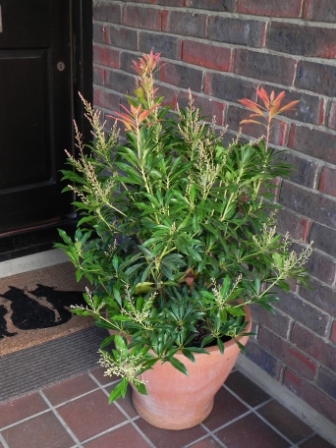
I never understand why more gardeners don’t grow Pieris. This lovely shrub is commonly known as lily of the valley bush, because of its delicate sprays of bell-shaped flowers that resemble convallaria without the scent. Pieris tick so many boxes in the quest for the ideal shrub: evergreen, attractive foliage, manageable, pest free, pretty sprays of buds through the winter months, beautiful long-lasting flowers early in the year and striking, often brightly coloured new foliage.
They are ericaceous, so will not grow on chalk or other alkaline soils, so that puts some gardeners off at the outset.  However you can grow them very successfully in pots using lime-free compost, where they will be just as happy as azaleas, camellias and compact rhododendrons, and they have a much longer season of interest.
In colder areas the new growth can be susceptible to frost damage, especially if caught by the early morning sun after a freezing night. However if you grow a pieris in a sheltered spot close to the house, perhaps on a porch or under the eaves, it will be protected from damage.  Even if the new growth does get caught by frost they will soon produced a replacement flush of showy new leaves.


So what’s the drawback? There isn’t one. Pieris are long-term subjects for pots and what is more they are good in pots in shade. They look good throughout the year, and certainly thrive much better than short term flowering subjects in a shady spot.  Some eventually grow bigger than others, but they can be carefully pruned after flowering to restrict their size and influence their shape. Pruning promotes new growth and colourful new leaves, but you do not have to do it to achieve this.
There are many different varieties to choose from, all with either pink or white flowers, or shades inbetween. Some have plain green, shining foliage; others are variegated with cream and white. The colour of new growth varies from chestnut to scarlet, cream to pink.  The best known variety, which has been a garden favourite for years is Pieris ‘Forest Flame’, loved for its white lily-of-the-valley flowers and scarlet new growth.  The foliage is emerald green, glossy and the perfect setting for both.  ‘Forest Flame’ is a strong-growing variety with an elegant upright habit.  A 10 litre plant in a large terracotta or glazed pot will make real impact instantly.
Pieris ‘Flaming Silver’ is a lovely variegated form with pink to crimson new growth and white flowers.  Its silver-white variegated dark green leaves are its greatest attribute and really show off the bright new growth. it is a little less vigorous than ‘Forest Flame’ with a bushy, well-branched habit.
Pieris ‘Valley Valentine’ is a pieris that is grown for the beauty of its flowers. Branched sprays of deep pink flowers open from deep red buds in early spring.  The foliage is dark and glossy and the new growth red-brown.  This is a more compact spreading plant, perfect for a pot and a real delight.
The time to buy a pieris is now: you will have the pleasure of it throughout the winter months, and you have flowers and new growth to look forward to in spring.  Pieris are great value plants and it is worth spending a little more to buy a larger, 10 litre specimen which will create a real impression from day one. Remember, pieris make great gifts – personally I would rather have a pieris than a poinsettia!
Recipe for success
Pieris really are perfect for pots; always grow them in lime free John Innes (John Innes ericaceous) compost. Water regularly and feed once a year with a granular fertiliser specifically for ericaceous plants.