Saturday, 11 May 2013

First day on site for Hillier @The_RHS Chelsea Flower Show The Arrival of the Treebeard and the Ents


A cool grey morning and a few spots of rain. My first thoughts are for the plane trees at showground. At least they will not be shedding that confounded choking dust that instils a feeling of impending pneumonia on arrival.  Sad news as I am driving to the station: Olympian Andrew “Bart” Simpson has been killed in a sailing accident in San Francisco bay. I first met Andrew in Cascais when I went out to Portugal; to meet The British Sailing Team at the beginning of the Skandia Sail for Gold Chelsea project just before the Beijing Olympics. He was such a nice guy and a great sailor and a wonderful host during my stay in Cascais and again in Weymouth. Have followed his progress ever since. Tragic.
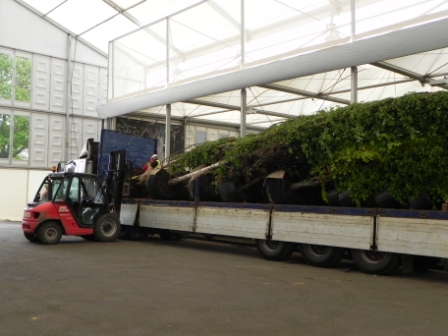
My thoughts heading for London on the train turn to the big trees arriving later today.  I know the guys are on site: Nigel tweeted about covering the site with black polythene: the first job before we mark out the plan an start construction.  The BBC are due to film the arrival of the trees. My concern: I hope they fit. Rick and I have picked some monumental multi-stemmed birches. I normally go for more variety, this year I’m going for repetition.   I they work they’ll look phenomenal; if they are too tall for the Pavilion..............I’m not sure. 


We also picked one very big Cedrus deodara ‘Aurea’. It’s very wide and I’ve planned to use it near to the embankment end of the exhibit. Will it be too heavy and yellow with my crystal fountains?
Maybe I should explain: at the centre of each of the Aqua Corona pools by fibreglass moulding specialists Sui Generis are sculptures in glass an copper by Mehrdad Tafreshi of Quist. These are just being made and they are in my imagination and Mehrdad’s; are they the same?  I see them as fallen or inverted chandeliers in pink crystal: something between Doctor Who and Phantom of the Opera. I wonder how he sees them?
In my imagination they demand silver foliage, sapphire ceanothus and soft pink rhododendrons. But is that too safe? This is supposed to be risky after all!
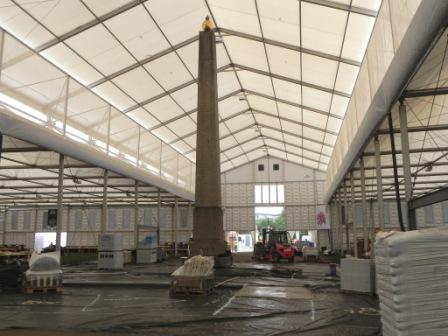
By the time I arrive on site around 11a.m Steve and Luke are with Brian laying out the paving for the pathway. The plan is already marked out: the building looks like a big space. I hope that I’ve left enough room for the planting. The lorry with the trees is in the Pavilion – a very big artic. With very big trees. Help! There is a cameraman and sound man from the BBC waiting to capture the moment.
The sheets are soon off the lorry. Two of the multi-stemmed birches are the first to come off; they are enormous. It’s certainly nerve racking watching Neil lift the rootball with Ben adjusting the straps as necessary an directing from the lorry. Nigel is on the top of the load lifting and pushing the head of the tree to release it from those that lie beneath. We gradually get the tree to the ground and then it takes all of us to “walk” it upright. It reaches to within a few centimetres of the roof of the Great Pavilion; it’s close! We’ve made some makeshift ramps with sand and timber to help the forklift to make the move across the monument plinth. Neil and Nigel are confident; I’m optimistic but can’t help envisaging one of these Ents crashing down and taking the Monument with it. 
Gradually all the trees are coaxed into position. I try to balance the colour and form through the picture. I know if I get this stage right its easier as we work down though the layers.  It’s really important not to have any voids in the upper canopy, or areas where the foliage is just too heavy.  I have to say that our trees have a lot more foliage than most in the showground.

By the end of the day the trees are in position and watered, the path is progressing well. We discuss the levels of the pools and adjust the position of the building. Good progress. 

The boys have set up their camp on site complete with fridge, kettle, mugs and chairs. It has a homely feeling and seems strangely familiar. Have we ever left or is this a continuation of last year. As I head out of the Pavilion I take in the comforting chaos of the outside gardens and the embryo trade stands. Everyone has that focused confusion that I recognise as the key to evolution of this extraordinary place. The dread of Chelsea on the horizon has evaporated; it feels good to be back home on Planet Chelsea!

Thursday, 9 May 2013

@The_RHS Chelsea Flower Show 2013 – A day in the life of the staging team


Friday 10th May is our first day on site at RHS Chelsea 2013. We arrive to an almost empty Pavilion with the Monument in the centre.  That’s our home for the next couple of weeks.  Ricky and I have selected our trees for the show and the big ones arrive on that first day; when I say big, I mean big.  The multi-stemmed Betula pendula are extremely tall, by the time those of you that are staging the exhibit arrive on site you’ll know if they fit or not! We are told that the BBC will be on site to film the arrival of the trees.  I hope they look impressive and all goes according to plan.

Next Tuesday – 14th May is our Staging Team Briefing, for those team members that can make it. I’ll tell you how things are going, what to expect and answer any of your questions before we arrive on site the following day, or on the Thursday. You’ll get your passes, high viz jackets, Showa gloves and details of where we are staying just off the Gloucester Road in the apartments we’ve used for the past few years. We’ll load up the minibus with essential supplies, such as the beer and wine for the bar in my room for pre-dinner drinks, and Sue’s tool kit ready for the following day.

The following morning Chris Wilde from Banbury garden centre (it’s his first year as part of the staging team) will meet those of us travelling from Hampshire at Ampfield house at 5.45 a.m. ready to head off for London. We want to be on site at 8 a.m. if possible ready to meet the first lorry delivering our plants.  On site we’ll meet Nigel and Neil, Steve and Luke will have finished by then and will have headed back to Hampshire.  We’ll also meet Jamie from Wakefield, Gillian from the Chelsea Physic Garden and Owen from London who are joining the team in London. 


The first day is all about unloading the first three lorries of plants, watering, untying and preening the plants. We also want to get as many of the larger plants into position as possible. To make space for another three lorries of plants and more of the staging team the following day.  No, that’s not it.  There will still be three lorries of plants on Friday and two on Saturday.  
There is catering on site and we’ll use this for lunch and breaks on the Wednesday, but we will have a tea station up and running on the exhibit on the Thursday. On the first day we’ll work ‘til around 6 and then head to the apartments to check in: showers, drinks and then out to eat.  Nigel and Neil will have booked somewhere for us to eat that evening.  We do something similar each evening – meet for drinks in my room and then we book a restaurant for everyone; nothing smart but good food and good fun.

Our daily regime is meet at 7a.m. – head off to the cafĂ©. Not saying which one on here; we don’t want too many others to join us! Arrive at the show at 8a.m. Break for lunch around 12.30 - work until 6 or later if necessary. 


During the first day you will find there is a bit of standing around for some of you until we really get into the staging routine.   From Thursday we start to split up into smaller staging teams working on specific areas of the exhibit.  I’ll give you a brief. Tell you what I’m looking for in terms of a colour theme and then I’ll help to get you started. You’ll find your creativity develops as we go along and we all get inspired by the plants.

However it’s not all about painting with plants there’s lots of heavier prep work to do: cleaning up, closing up the plants as they thin out, breaking down Danish trollies, lugging bales of bark.  Believe me, no job is more important on the exhibit than any other – all tasks are part of the creation of the Hillier exhibit; never think that a menial task is unimportant! 

Friday, 3 May 2013

@The_RHS Chelsea 2013 – Team Briefing 2 – Only a week to go!

This is the second instalment of my briefing for Team Hillier at Chelsea 2013.  It’s now just one week until we start work on site, and just over two weeks until the show opens.  The warmer weather and sunshine has brought the plants on from where they were, but there is still a long way to go.  This transition from cold and dull to bright, warm and sunny does bring its challenges.  Tender new leaves do not have time to build up resistance  so it’s a challenge for Ricky to protect them from scorch, to keep them watered and move things into the cold store as they bloom.  After such a long slog to get the flowering subjects to perform we do not want to lose any because they have gone past their best.

Anyway it’s about time to tell you a little about how it all happens. On Thursday 9th May we’ll be loading up any construction materials that we are taking with us along with tools and equipment.  Nigel Roman takes care of this and he’s a key member of the Chelsea team from day one to the last day of build-up.  Nigel originally worked for Hillier Landscapes, but today has his own landscape business. I’m delighted to say that he still comes back for Chelsea 
Then on the Friday morning the Hillier build team head for London in time to meet that lorry that was loaded the day before.  Perhaps the most essential bit of kit that goes with us is our fork lift which will work very hard over the next few days.

This is driven by Neil Robins. Neil is section head on Brentry container production unit.  He’s been part of the Chelsea team for over twenty years and as far as I’m concerned he’s in charge of operations; site foreman.  He is also responsible for Health and Safety, vehicle movements, unloading, loading and generally how we work on site. Neil is a remarkable fork lift driver and his skills are put to the test from Friday morning when the construction materials start to be delivered to site. These include: sand, ballast, 600 building blocks, paving, buildings, timber edging, pots, sculptures, buildings and so on.
Then there are our two landscape construction specialists Steve Richmond and his son Luke Richmond and myself. Steve and Luke lay the paving for the main walkway through the exhibit, the bases for the buildings, water features and sculptures. They use a constant supply of mortar mixed for them by Nigel and his trusty mixer.  Mr Mix will make 100+ mixes during the build and will use 16 tones of sand, 100 bags of cement and 2 tons of ballast. 
Brian from organicstone will join us on site with his delivery of amazing paving to create the walkway and feature paved areas within the Hillier Garden. Brian never leaves anything to chance and I know he will have put an incredible amount of thought and preparation to make it as easy as possible for my landscaping crew.
Before we can start on construction we cover the whole site with black polythene sheeting and mark out my plan on the ground. Adjustments to the positions of features invariably have to be made due to unforeseen obstacles, like the supports of the pavilion or water or drainage pipes.


This year we have taken the decision to deliver in the biggest of the trees on Friday. This is a day earlier than recent years but Neil rightly points out that it will be easier to get them into place before we surround them with paving    that we can’t drive the forklift over.  This type of logistic decision is Neil’s speciality.

The team then have the rest of Friday, Saturday, Sunday and Monday to do as much of the hard landscaping as possible. The first of the plants, more trees and the big shrubs arrive on Tuesday so things start to get a little more crowded.

In addition to our build team we will have help from M&M Timber – They arrive on Saturday 11th May to construct the deck, build the Sydney Sunroom, the outdoor living space, and install the timber edging.
Suigeneris arrive on Monday to deliver the Camber seating and install the Corona water features, all made from fibreglass. I’m looking forward to seeing these – they look amazing but what will they look like at Chelsea?

Next time: the staging team. For some of you that means you.  I’ll tell you what to expect from a normal day at Chelsea Flower Show. What am I talking about?...........normal is not really the right word!

Saturday, 27 April 2013

@The_RHS Chelsea Flower Show 2013 - Hillier Team Briefing - Risk!


Over the past few years I have shared my thoughts and experiences in the build up to Chelsea Flower Show through this blog. This year I thought I would include you all as members of the Hillier Team; your support, interest and commitment to the Show are so important to our success, whether you are staging plants, organising transport, building the foundations, taking the pictures, labelling, visiting the show, following on the internet or any one of the many other tasks involved in making it happen. Yes, there are key players in the team, but none of it can come together or be worthwhile without all of you.

The team that actually builds the Hillier exhibit comes together from all over: from different parts of the Hiilier Nurseries and Garden Centres, from the Sir Harold Hillier Gardens, from gardening and the horticultural world at large. Few of us normally work together, some of us haven’t ever met before when we arrive on site. Some have this Chelsea experience only once in their lives; some come back for more.  

Personally I have been responsible for the exhibit for 20 something years; before that I visited the show and sometimes manned the exhibit in show week.  My objective has always been to create a garden exhibit which visitors can relate to; one that will inspire but one which gives ideas that gardeners could create in their own gardens.  The story is new each year, but the palette of plants is similar. That is the challenge: create a new look out of the same ingredients. So far we have always succeeded.
Many believe that my primary concern is the Gold Medal. Yes, it’s important. Last year was our 67th consecutive Gold Medal and we currently hold the Guinness World Record for the most consecutive Gold Medals at Chelsea Flower Show. Maybe we’ll add to that total this year, but that depends on the plants and what we do with them.  It also depends on whether the judges like what we do. It’s my design and choice of how it looks. I hope I get it right for all of us. My two objectives and main concerns every year are firstly getting the job done; believe me that’s a challenge in itself.  Secondly, and most importantly I want everyone involved to feel that this is the best thing they’ve ever done and an experience to remember.
The theme is Risk! Our partners are Beazley, specialist Lloyd’s insurers. I won’t bother to tell you more about the concept: If you haven’t done so already read this:  

Those of you working on the exhibit will find yourselves doing all sorts of tasks: unloading, watering, lifting, tidying, staging, sweeping, painting: some tasks may be wildly creative; many won’t.  It’s a team effort and we all do a bit of everything. You will never be expected to do anything beyond your capabilities. 

I impress on everyone at the outset: Don’t attempt to lift anything on your own that’s too heavy.  Many of the plants are a two or three man lift and there are about 3,500 of them. It’s not a race; take your time.  Safety is paramount. Accidents cost time and trouble and can ruin anyone’s Chelsea experience so let’s stay safe.
Space is limited around the exhibit. Unload and set down plants carefully and sensibly, taking care not to cause any damage to our stock or neighbouring exhibitors’ plants.  We don’t want any of our big, heavy, bony shrubs to be the demise of a vase of tulips or a delicate little alpine.
There will be a fair bit of standing around for those of you joining at the outset. There’s no planting plan and I may need a bit of thinking time! Many of the shrubs and trees are tied up to avoid damage. Untie them and cut off any damaged branches or broken leaves that you see.  Wear gloves and look after your secateurs: I admit I have a habit of borrowing them.

If the weather is warm and dry it can be very dusty in the Pavilion. This is caused partly by the ground, partly by the shrubs, but most of all by the irritating fallout from the Plane Trees.  If you suffer from hay fever, asthma or any other respiratory conditions I recommend you wear a dust mask.  We will provide these but you may prefer to bring your own.
Right the way through staging you must wear High-vis waistcoats; we supply these rather fetching garments.  You must wear safety footwear. This isn’t an RHS requirement by the weekend, but I insist that you wear it on the Hillier exhibit.

This all sounds very dreary and I bet some will be wondering what they are coming to. Those of you looking on may be a bit surprised: but that’s the whole point, I want to take you with us behind the scenes..............


Tim - with the only plant he's ever lifted - typical photographer - a moment worth capturing! 

Tuesday, 16 April 2013

@The_RHS Chelsea - Slow Progress


There seems to be rather a long gap between my Chelsea blog posts this year; perhaps that’s because everything has been moving rather slowly.  There are now only five weeks until the show; that is more than a little worrying.  I know exhibitors always say that, but the cold weather and low light means that plants are generally way behind.  In the gardens the forsythia is just about blooming and here in Hampshire Magnolias are opening their glorious spring flowers. Does that mean more frosts and high winds to come?

Sorry to be pessimistic, but this has been such an appalling season so far it is quite hard to see the light at the end of the tunnel.


I had a look around the Chelsea show plants at the end of last week with Ricky. Outside the conditions were Polar, in the glass they were little better.  By now we usually have quite a lot of the plants in cold storage.  This year Ricky has taken the cherries out of the cold store to try and get the buds to move. Cornus, the flowering dogwoods are some of our star plants.  Last year they hardy produced any flowers and were sadly missed.  This year they are loaded with buds but they have a long way to go if we are going to show them.

The Japanese maples are unfurling slowly and surely. Now, they could be very good because they are coming into leaf slowly rather than producing masses of soft foliage due to higher temperatures.  The risk is that we will suddenly get those high temperatures and they’ll move apace.  Of course they then demand very regular watering, maybe three times a day.  They will also need shading to avoid scorch under glass.

Likewise the foliage dogwoods, including my favourite Cornus controversa ‘Variegata’ look good, if further behind than usual. Cornus ‘Hedgerows Gold’ is barely shooting and this is normally in full leaf by now.  But then I’m still enjoying the winter stems of Cornus ‘Midwinter Fire’ in my garden, whereas normally they would be employed as pea sticks by this time.

Hostas are shooting promisingly, but the ferns are remaining tightly curled up in brown, scaly mounds on the compost surface.  We do rely on these plants to lighten and soften our shade planting so hopefully they will get a move on soon.


So what about the colour? The rhododendrons and azaleas look great but the buds are showing little sign of colour. That may be a good thing. Although they can be cold stored for several weeks they age quickly when we bring them out from the cold.  If we can take as many as possible from the nursery straight to the show the flowers will last in better condition for the duration.

The roses need warmth and some sunshine. We have been in this position before, but we have not always had great roses.  One of our best years was the year we did the canal right up to the monument. We filled the beds on each side of it with roses taken straight from the nursery beds.  It must have been a warm spring.  I remember it very clearly because Margaret Thatcher visited the show on the Monday.  I remember her standing at the head of the canal framed by vintage roses and the trimmed hornbeams.

That was one of our finest Chelsea exhibits; we won the Lawrence medal for it. Next year it’s our 150th birthday – I’m tempted to recreate the canal exhibit at Chelsea to celebrate. Best not to think about that right now – I’ve got Chelsea 2013 to get through first.

Friday, 22 March 2013

@The_RHS Chelsea - Talking Sculpture

The grim weather certainly makes Chelsea seem a long way off; only a week of March left, then Easter, and just a few manic weeks of last minute preparation.  Although it seems as if I’ve done very little about the Show, it’s surprising how many things have fallen into place, even if I haven’t written about them here.Tom Stogdon has already come up with some amazing sculptural creations in steel and slate, but up until last week I hadn’t caught up with Mehrdad Tafreshi.
His work has featured on the Hillier exhibit many times. Remember that amazing glass sail he made for Sail for Gold? Or maybe you remember the aqua glass and copper that rose out of Venetian adventure in ‘Adventures in Gardening?  He’s perhaps best known for his weeping trees. I used them in ‘Planting with Trees’ and also in ‘A Music Lover’s Garden’.  It’s difficult to remember which came first but them I found some old pictures of A Music Lover’s Garden from 2004. 

That was the first year that we were back on the Monument, when it was incorporated into the central atrium of The Great Pavilion for the Bicentenary of The Royal Horticultural Society. I remember the bell tower, centrepiece of In a Monastery Garden was one of our toughest builds, but it was a show stopper. As ever, I wish I could take another look at the real thing. I also remember that weeping tree in Walk to the Paradise Garden. I remember how the light caught it amidst the jewel colours of the rhododendrons.

 Anyway back to Mehrdad. We eventually got together last Friday to discuss centrepieces for my two contemporary pools. These are sleek, smooth and sophisticated. I had a vision of glass crystals rising from the pools through gushing fountains. As it happens we seem to be thinking along the same lines. The realisation of the vision will tell if we are, however neither of us will see what it really looks like, until we drop Mehrdad’s sculptures into those pools at Chelsea. Risk? – No, never; Trust!  I know he’ll produce something that’s just amazing.  To reassure myself I took a look at the piece he made for the centre of Grand Designs….

 Had my first meeting with the Chelsea construction team.  Neil, Nigel, Steve and Luke seem as laid back as ever, which is just as well as I still haven’t done a plan – next week I promise.  I suppose the main concern all round is the weather. This prolonged, cold weather is not coaxing planting into growth; most of the show plants still tell me it is winter.  There is still plenty of time, and we certainly don’t want to be cold storing things for too long, but we do need to see some movement.  Interestingly enough 2004 was another cold spring.  I remember doing a pre Chelsea tour at the beginning of May and the Music Lover’s Rose, which we launched in association with Classic FM wasn’t even in leaf. However despite its reluctance, it made it for the show. Mother Nature and the Gods are always in control!

Tuesday, 26 February 2013

@The_RHS Chelsea – Feeling the force of gravity

As the last few days of February slip away into oblivion, March looms and I start to feel the force of gravity of Planet Chelsea. It’s not a good idea to flip through the diary at this stage; too few pages separate me from May.  Every year I mean to be ahead of the game, but in reality I avoid the issue until timescale threatens.

Some aspects of this year’s exhibit have bonded in the past couple of weeks.  Organicstone, as ever have felt the force and come up with just the right flooring products for pathway and feature paving. Tom Stogdon has sent through some amazing images of his sculptures. We’ve decided on a building from M&M Timber, and almost decided on colours.  A curious fibreglass object that’s sitting in front of my desk is raising a few eyebrows.  “What is it?” they ask. “Isn’t it obvious?” I reply; clearly not. 

My desk is an untidy heap of papers, brochures, post-it notes and a few scribbled lines on a plan. The Chelsea plant list has got as far as my “things to do” list.  Some of the Chelsea mag is written and the concept clearly explained; well fairly clearly. This year’s theme….I’ll tell you that after Friday. I said I would do that at Hillier Horsham on Friday.  Some already know. But if you do please don’t tell anyone yet. I think every major piece of news needs a release date and in the best media traditions that news is bound to be leaked beforehand.

I was at a conference for Floral Exhibitors (as opposed to Garden Exhibitors and purveyors of garden goods) at The RHS in London last week.  Interesting day talking rules of judging, social media etc.  I thought we would be discussing the Centenary of Chelsea, but that wasn’t really mentioned. Anyway what the meeting achieved was about of a pre-show reunion of exhibitors.  It was nice to get to see the Chelsea family before the show. It means you can get the “it doesn’t seem five minutes!” out of the way early.